How does the Ladder league format work in Padelio?
Last updated 2026-09-15
A ladder season is a ranked pyramid. Every player holds a rank inside a Liga (a division), and each cycle the ladder is chunked into groups of four consecutive ranks. A group plays an all-partner rotation — everyone partners everyone else once — and when the cycle closes, each boundary between adjacent groups swaps one player up and one down. Cycles run inside one season, so a whole playing year keeps a single ladder, a single chat, and one set of playoffs at the end. Ladder is in Beta.
The shape of it
Most league formats ask "who is on your team?". A ladder asks "where do you stand?" — and then rebuilds the fixtures around that answer every few weeks.
Season            the playing year — one ladder, one chat, one playoff
 └── Cycle        one round of play, typically 4–6 weeks
      └── Liga    a real skill tier (Liga 1 above Liga 2, and so on)
           └── Group   four consecutive ranks, playing among themselves
Four words carry the format:
- Liga — a division. Ladder seasons always use divisions; the ladder views label them Ligas. Liga 1 sits above Liga 2, and a rank in Liga 1 always beats any rank in Liga 2.
- Cycle — one round of play. Groups and fixtures belong to a cycle, not to the season, so each cycle regroups everyone from scratch.
- Group — four players (by default) of consecutive rank, who play only each other.
- Rank — your position inside your Liga. It only changes when a cycle closes.
The groups are ordered continuously across the whole season, so the bottom group of Liga 1 sits immediately above the top group of Liga 2. Promotion out of Liga 2 is the same "up one group" rule as promotion inside it — there's no separate cross-Liga rule to learn.
Before you start
- It's a doubles format. A group plays doubles, so singles leagues don't offer it.
- It needs divisions, which need a paid plan. A ladder's Ligas are its divisions, so the divisions toggle is switched on for you and can't be turned off. Divisions are a Pro feature — see leagues/divisions.
- You need at least two Ligas, and at least one full group before a cycle can open. With the default group size that's four players in one Liga; realistically, plan for four or more in every Liga.
- The format is locked once the season exists. Decide before you create it.
Creating a ladder season
Two entry points, same result:
- New league — Create → League, then on the season step pick Ladder (it carries a Beta pill).
- New season in an existing league — the Create season dialog, Format → Ladder.
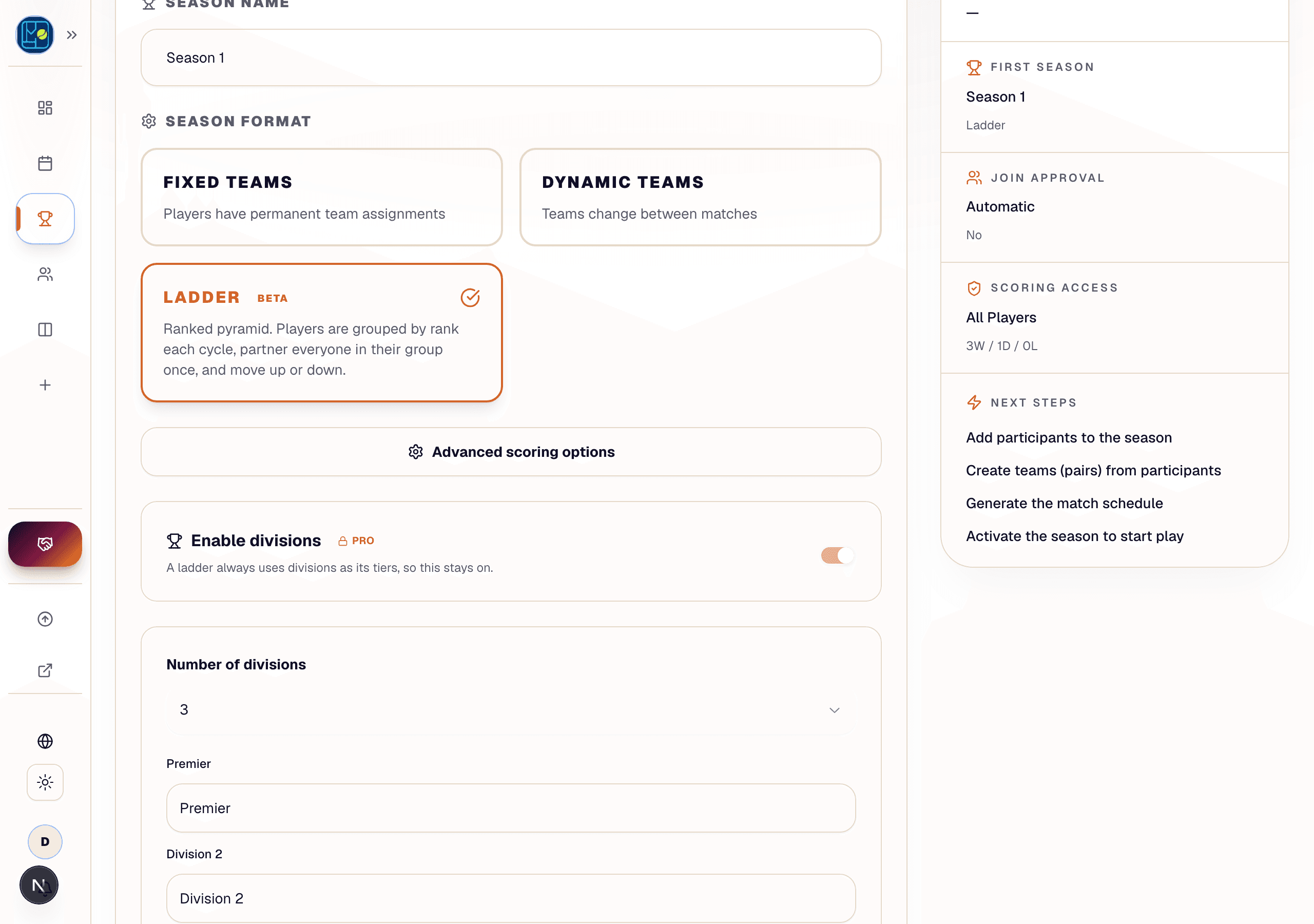
Either way the divisions section switches itself on. Name your Ligas the way your club talks about them (Liga 1–4, Premier/Challenger, whatever fits), add players from the Members tab, and assign each one a Liga — that assignment is what puts them on the ladder.
The season stays in Draft at this point. You don't activate it by hand: starting the first cycle does that for you.
Running a cycle
Everything lives on the Ladder tab, which always shows exactly one primary action: open, start, or close.
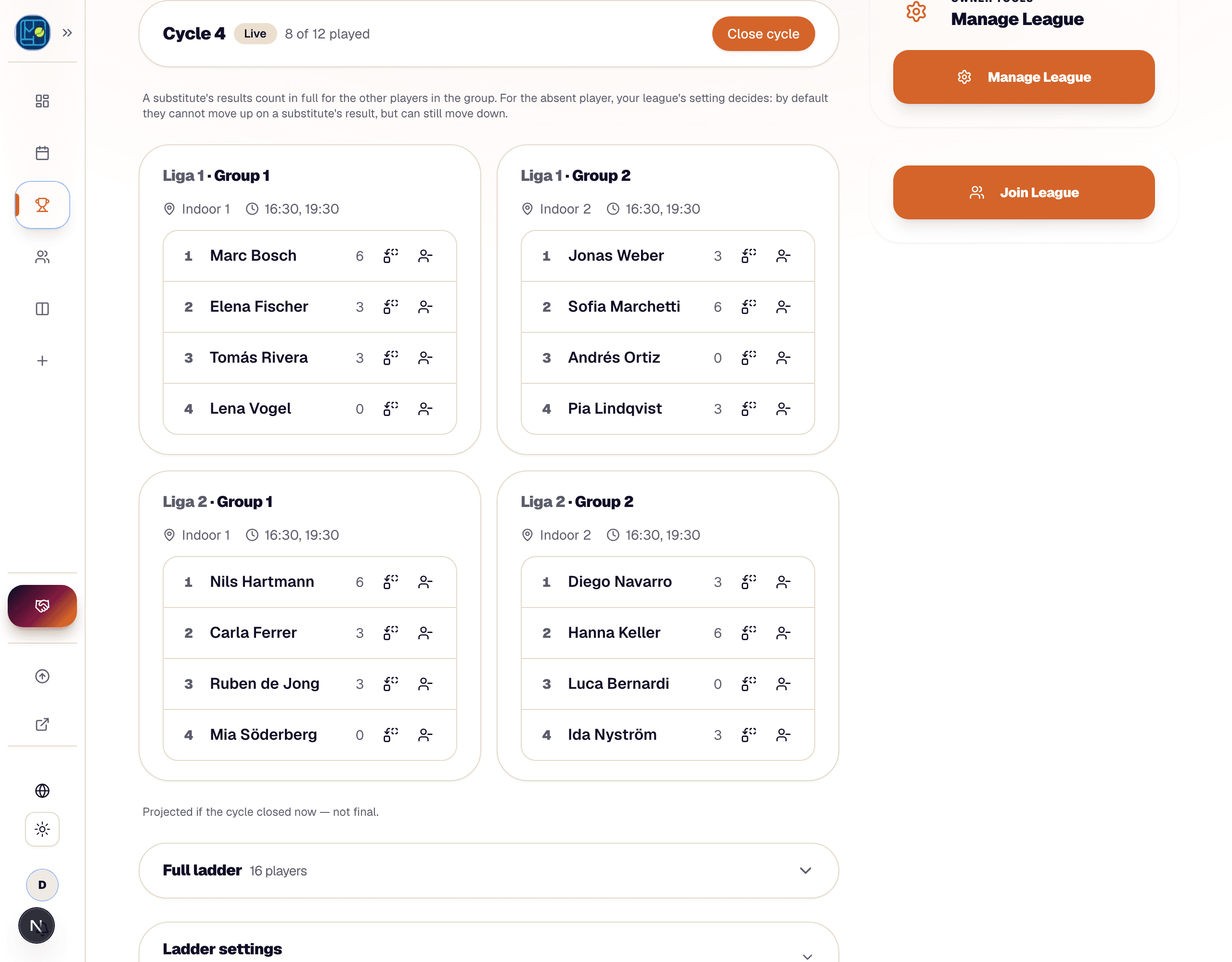
Step 1 — Open the cycle
Press Open Cycle 1. Padelio ranks anyone who doesn't have a rank yet (appending them to the bottom of their Liga in join order), chunks each Liga into groups by rank, and generates every group's fixtures in one go.
Players left over after the last complete group — three players at the bottom of a Liga of 15, say — are not put into an oversized group. They sit this cycle out and keep their rank. The tab says so, because a player parked for several cycles running is something you want to see rather than discover.
Step 2 — Review the draft
Nobody else sees the cycle until you start it. While it's a draft you can swap players between groups within a Liga, and — on the web — set each group's court and time slots. Something wrong at a deeper level? Discard draft deletes its groups and fixtures without touching anyone's rank.
Step 3 — Start it
Start cycle opens the cycle for scoring. If the season is still in Draft, this activates it too — that's the moment your players can enter results.
Step 4 — Play and score
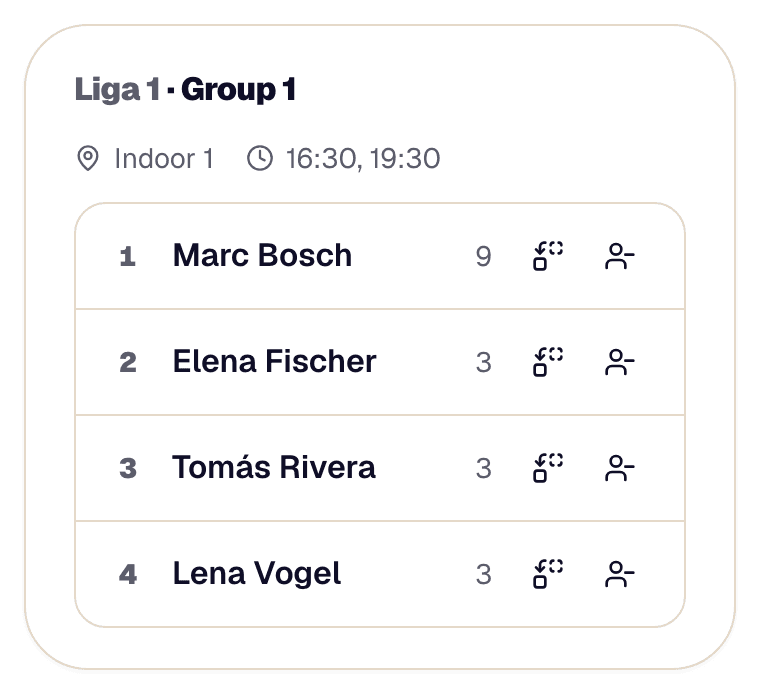
Fixtures appear on the Schedule tab grouped by cycle, Liga and group, and they're ordinary league matches: the same score entry, the same match chat, the same organiser-only-scoring setting if you use it. Each group card shows its own live mini-table, and the ladder shows a Projected arrow for where each player would land if the cycle closed right now.
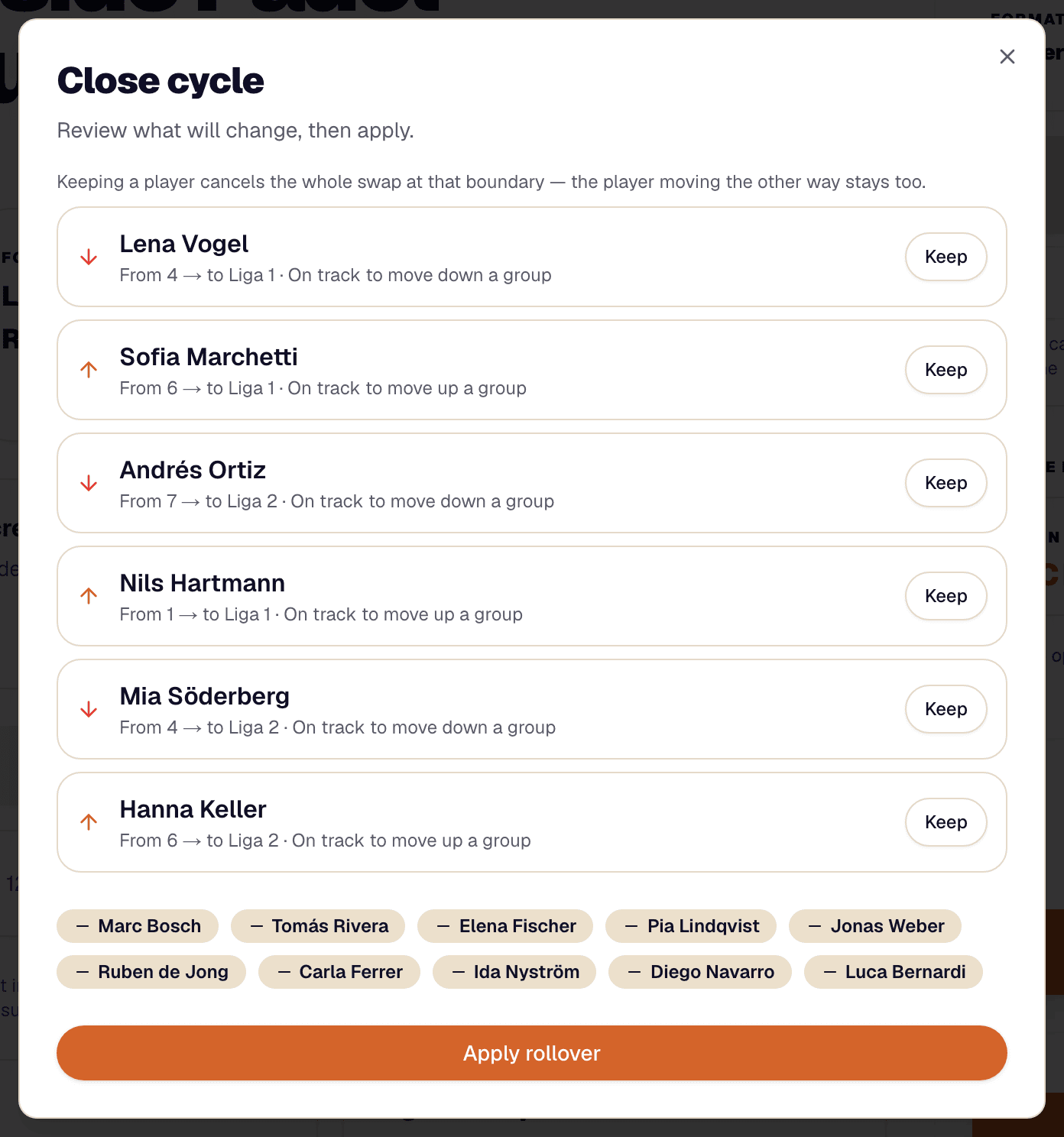
Step 5 — Close it
Close cycle opens the rollover review: who moves up, who moves down, who holds, and why. Adjust anything you disagree with, then Apply rollover — that's the only moment ranks actually change. Withdrawals and waiting-list placements are applied in the same step.
Then open the next cycle and go again. A season is as many cycles as you want to run; the reference league that shaped this format runs roughly five a year at about six weeks each.
How movement works
At the end of a cycle, each boundary between two adjacent groups swaps exactly one player each way: the best eligible finisher from the lower group goes up, the last eligible finisher from the upper group comes down, and they trade ranks.
That "each way, as a pair" is the whole rule, and it's why a group never quietly changes size. If either side of a boundary can supply nobody eligible, the boundary doesn't swap at all rather than moving one player in isolation.
The rollover preview gives every player a reason:
| Reason | What it means |
|---|---|
| On track to move up a group | Promoted — takes the rank of the player coming down. |
| On track to move down a group | Relegated — takes the rank of the player going up. |
| Holding position | An ordinary mid-table hold. |
| A substitute played this seat | Your substitutes policy blocked a move this seat was in line for. The slot passes to the next eligible player. |
| No eligible player on the other side | This player was eligible and would have moved, but the other side of the boundary could supply nobody. |
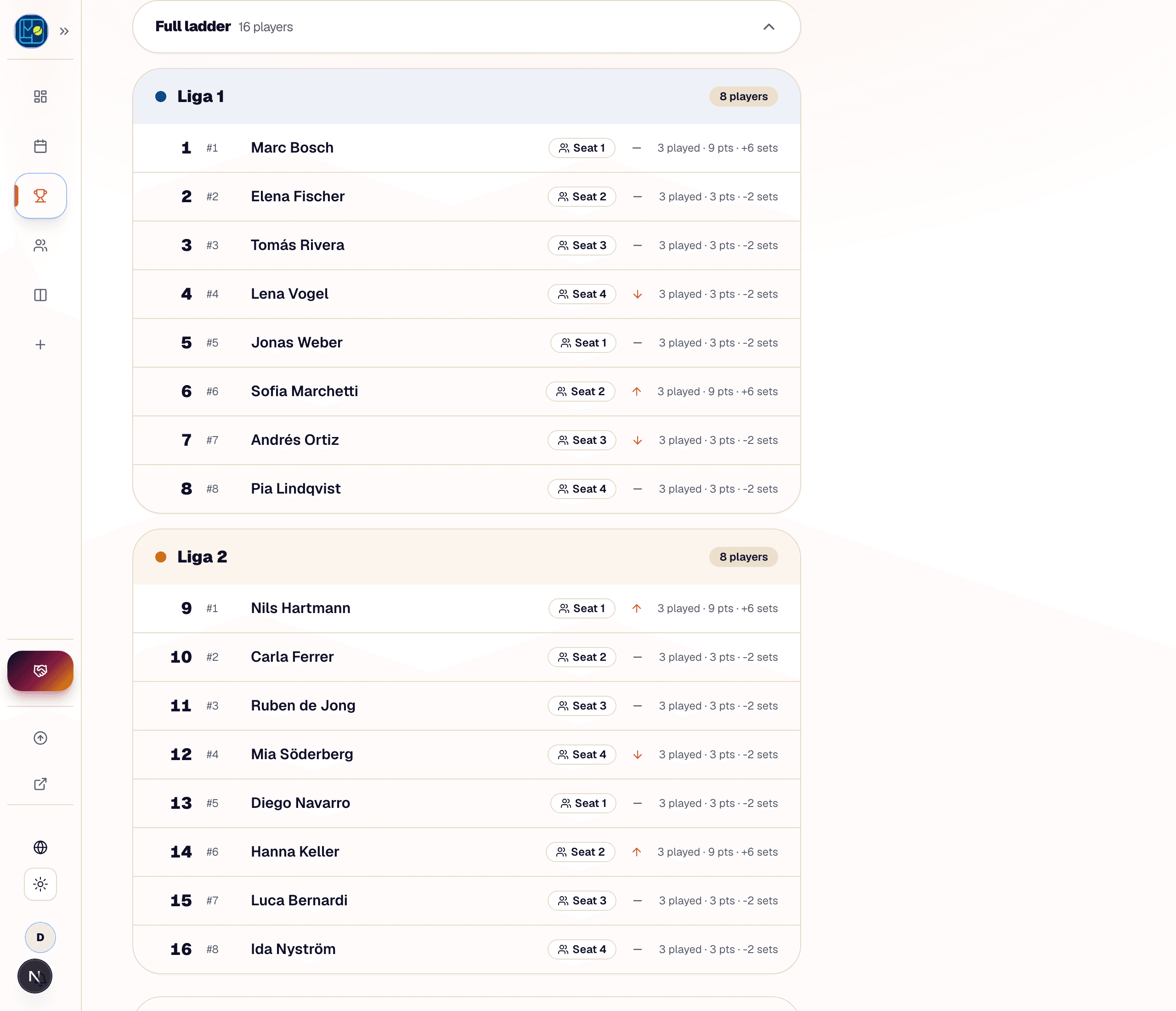
A few consequences worth knowing:
- The ends are closed. Nobody promotes out of the top group; nobody relegates out of the bottom one.
- Sitting out holds your rank. A player outside the last complete group takes no movement.
- Keeping a player cancels the whole swap. If you override one movement to Keep, the player moving the other way at that boundary stays too — otherwise the group sizes would drift apart.
Group size
Group size is set per Liga (Ladder settings → Group size), default 4, range 4–8. Four is the reference format: four players, three matches, everyone partners everyone once.
| Players | Matches | Matches per player | Everyone partners everyone? |
|---|---|---|---|
| 4 | 3 | 3 | Yes |
| 5 | 5 | 4 | Yes |
| 6 | 7 | 5 (two players get 4) | No — one pairing impossible |
| 7 | 10 | 6 (two players get 5) | No — one pairing impossible |
| 8 | 14 | 7 | Yes |
Six and seven can't be perfect. A doubles match consumes two partnerships at a time, and those sizes have an odd number of partnerships in total, so exactly one pairing is left unplayable and the two players in it end the cycle one partner short. Padelio warns you when a cycle contains such a group. If that bothers your players, use 4, 5 or 8.
Standings and tiebreaks
A group is scored on its own matches and nothing else. Wins and losses use your season's points values. If the season also awards points per set won, those count here too — a set won still counts in a lost match.
A ladder match can't end level. The group table exists to rank the players in it, and that feeds who moves up and who moves down, so a drawn result has nowhere to go. Padelio refuses to save one: enter a deciding set or tie-break and record the result. For the same reason the draw points field is hidden on a ladder season — it would never be awarded.
Ties are broken in this order:
- Match points
- Set difference
- Game difference
- Head-to-head — only between exactly two tied players. In an all-partner rotation a group of three or more tied players will usually have beaten each other in a circle, so there's no principled winner to find.
- Rank going into the cycle
Unplayed matches count for nothing at all — not a loss for anybody. You can close a cycle with results outstanding; the dialog tells you how many.
The season Standings tab isn't where a ladder's results live. The cycle's group tables are the scoreboard, and the ladder itself is the season-long ranking.
Substitutes, withdrawals and the waiting list
Substitutes. When someone can't play, put a stand-in on their seat from the live cycle's group card. The substitute plays that seat's matches, and the results always count in full for the other three players — one absence shouldn't erase three other people's evening.
What varies is what happens to the absent player's rank, which you set in Ladder settings → Substitutes:
| Setting | Effect |
|---|---|
| Cannot promote, can still relegate (default) | A stand-in can't win you a promotion, but a bad cycle still costs you. |
| No movement either way | Kindest to the absent player — but "I'll send a sub" becomes a way to dodge relegation. |
| The absent player takes the result | Simplest to explain, and fully open to sending a strong stand-in. |
Whenever a policy suppresses a movement, the slot passes to the next eligible player rather than going unused — a suppressed first place means second place promotes.
Withdrawals. Marking a player as withdrawn leaves their group playing short for the rest of the cycle; already-played matches stand. They leave the ladder when the cycle closes, and the ranks behind them close up.
Waiting list (web). New players don't have to join at the bottom. Add them to the waiting list from the Members tab with a suggested Liga and rank, and place them when the cycle closes — inserting mid-cycle would change a group that's already playing. Everyone below the insertion point shifts down one.
Playoffs
When no cycle is open, the Ladder tab offers Open playoffs — a doubles knockout that ends the year.
- Qualifiers — the top N of the season-wide ladder. A bracket needs 4, 8, 16 or 32; the default of 8 gives you semi-finals and a final, and quarter-finals need 16.
- Pairing — either pick the pairs yourself, or pair strongest with weakest automatically (1+8, 2+7, 3+6, 4+5). Either way, pairs are seeded into the bracket by their better-ranked partner, so the strongest pair meets the weakest first.
- Advancing — score every match in a round, then advance to the next.
A playoff decides a champion. It does not move the ladder, so there's no close-cycle step on it.
Ladder vs the other league formats
| Fixed teams | Dynamic teams | Ladder | |
|---|---|---|---|
| Who you play with | Your registered duo | Varies week to week | Everyone in your group, once each |
| Who you play | Every other team | Every other player | Only your group of four |
| Standings unit | Per team | Per player | Per player, per cycle group |
| Season-long ranking | Season table | Season table | The ladder |
| Divisions | Optional | Optional | Required (they're the Ligas) |
| Fixtures generated | Once per season | Once per season | Once per cycle |
If your group is stable and mixed-level and you want everyone playing people of their own standard every week, that's the ladder. If you want one table and one schedule for the whole season, see leagues/fixed-teams-vs-dynamic-teams.
Where to go next
- Setting the league up? leagues/create.
- Naming and configuring the Ligas: leagues/divisions.
- Adding players and join codes: leagues/add-teams.
- Season lifecycle: leagues/seasons-and-status.
FAQ
- Do I need a paid plan to run a ladder?
- Yes. A ladder's tiers are divisions, and divisions are a Pro feature — the league owner (or the hosting crew) needs a Pro or Crew subscription. The per-season participant cap follows your plan the same way it does for any league. See [getting-started/upgrading-to-paid](/docs/getting-started/upgrading-to-paid).
- Can I run a ladder in singles (1v1)?
- No. A ladder group plays an all-partner doubles rotation, so the format needs four players on court. Singles leagues don't offer the season-format picker at all — see [leagues/singles](/docs/leagues/singles).
- What happens if a ladder match ends 1-1?
- Padelio won't accept it. A ladder group table has to rank its players — that ranking is what decides who moves up and who moves down — so a drawn match has nowhere to go. Play a deciding set or tie-break and enter that result. The draw points field is hidden on a ladder season for the same reason.
- Can I convert an existing season to a ladder?
- No. The format is chosen when the season is created and can't be changed afterwards. Create a new ladder season instead — a league can run a dynamic-teams Season 1 and a ladder Season 2.
- How many players do I need?
- A season needs at least two Ligas, and a cycle can only open once at least one Liga holds a full group — four players by default. In practice, plan for at least four per Liga, or the thin ones will sit every cycle out.
- Why isn't a player showing on the ladder?
- They probably have no Liga. A ladder only ranks players who belong to a division, so anyone who joined by code without being assigned a tier stays off the ladder until you set one from the Members tab. Everyone in a Liga without a rank is appended to the bottom of that Liga the next time you open a cycle.
- Why did two players in a group get one match fewer?
- The group has six or seven players. A doubles match uses two partnerships, so a group whose total number of partnerships is odd — which is the case at six and seven — always leaves exactly one pairing unplayable. It's arithmetic, not a scheduling bug. Groups of 4, 5 or 8 come out perfect.
- Nobody moved between two groups this cycle. Why?
- A boundary swaps one player up and one down, and only ever as a pair. If either side can supply nobody eligible — everyone substituted under a freezing policy, or withdrawn — the boundary doesn't swap at all, and the rollover preview labels the affected player "No eligible player on the other side of the boundary". This keeps every group the same size.
- What happens to matches nobody played?
- Nothing. An unplayed match counts for nobody and against nobody — it isn't a loss. The close-cycle dialog warns you how many are still unscored so you can check that closing is deliberate.
- Can I generate a schedule from the Schedule tab?
- No. Ladder fixtures belong to a cycle and are created when you open one, so the usual generate-schedule tools are switched off. Ladder matches also can't be created one at a time — a manually created match would belong to no group and could not be scored into the ladder.
See something off? Suggest a fix — emails support@padelio.org with the article and a prefilled subject.